War, undoubtedly, brings destruction and uncertainty. However, even in such challenging times, strategic planning and innovations are vital for national resilience.
One of the most relevant and promising areas for investment during wartime is Renewable Energy Sources (RES). This trend is confirmed by growing global interest: according to the International Energy Agency (IEA), global investments in clean energy for the first time exceeded investment in fossil fuels in 2023. Investments in RES not only contribute to strengthening energy independence and security but also offer significant economic and ecological potential.
Energy security and independence
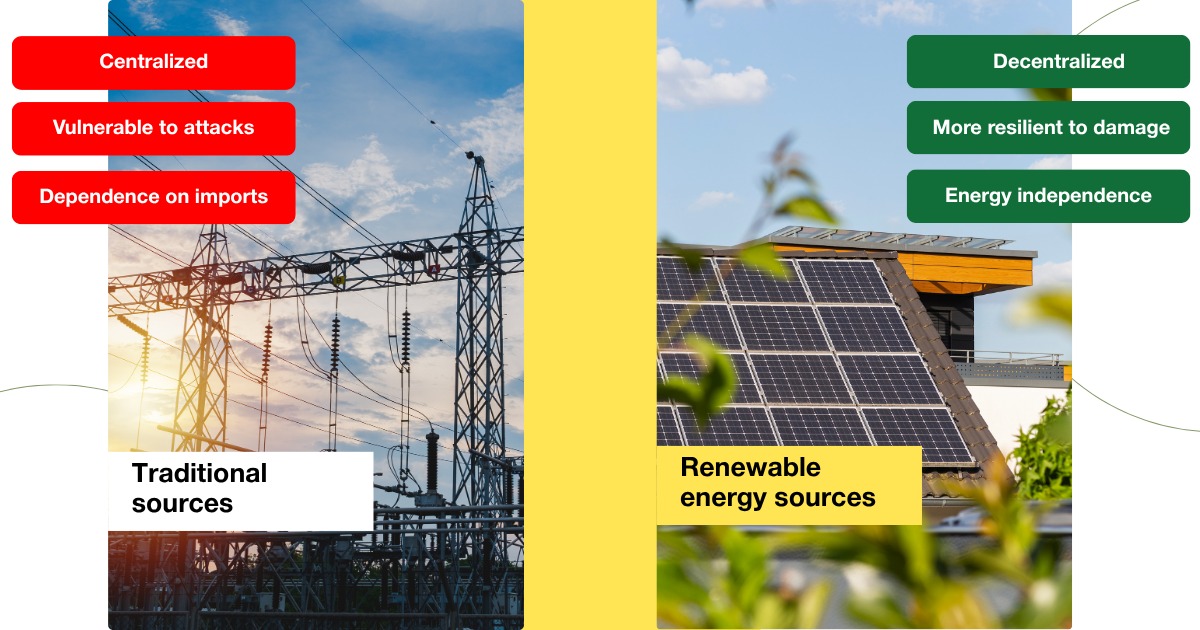
Traditional energy sources, such as oil, gas, and coal, are often objects of geopolitical manipulation and military conflict. The infrastructure that ensures their transportation and extraction is vulnerable to attacks.
Renewable energy sources, like solar and wind power, are distributed and decentralized. This means their production can be located closer to the consumer, significantly reducing the risks associated with damage to large, centralized power plants and grids. This decentralized architecture provides critical stability when centralized infrastructure fails.
Economic resilience and recovery
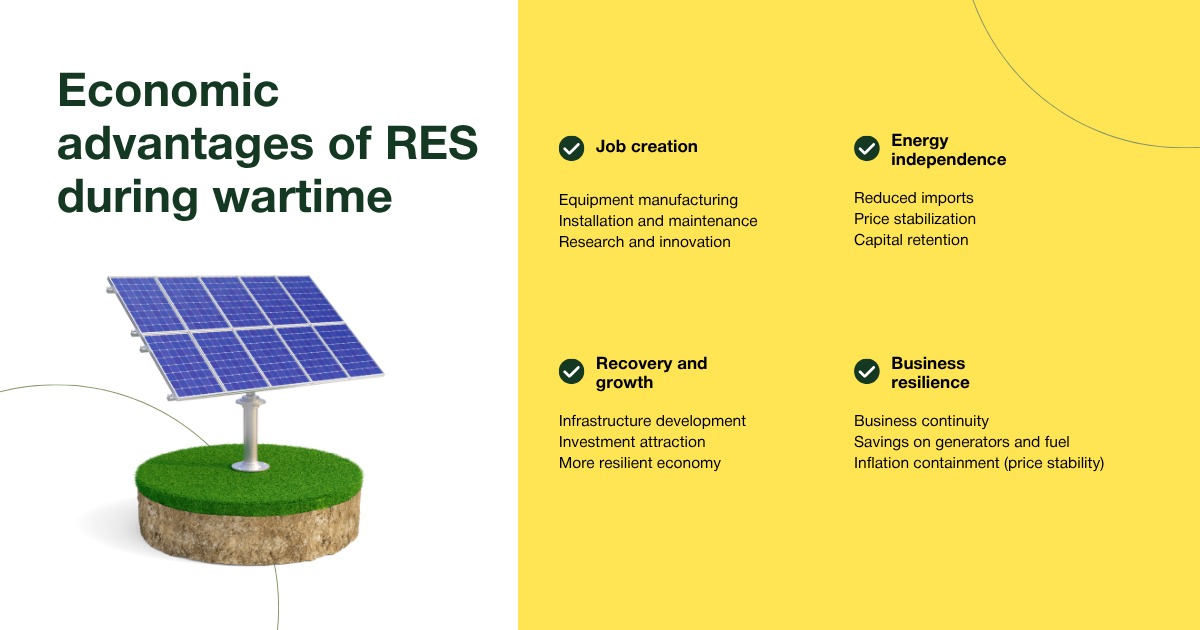
During wartime, the economy suffers from damage and instability. Investments in RES create new jobs in manufacturing, installation, maintenance, and research sectors, contributing to economic recovery and development. Furthermore, reduced dependence on imported energy resources limits capital outflow from the country and helps stabilize energy prices.
Crucially, decentralized RES systems (especially solar power and batteries) allow local businesses to maintain operations during massive shelling and emergency blackouts. By ensuring uninterrupted power supply, enterprises—from bakeries to industrial workshops—can save on expensive generators and fuel. This energy autonomy helps contain price hikes for final goods and services, mitigating inflationary pressure and ensuring people have stable access to essential goods and services. This is a direct investment in the long-term viability of the local economy.
Speed of deployment and modularity
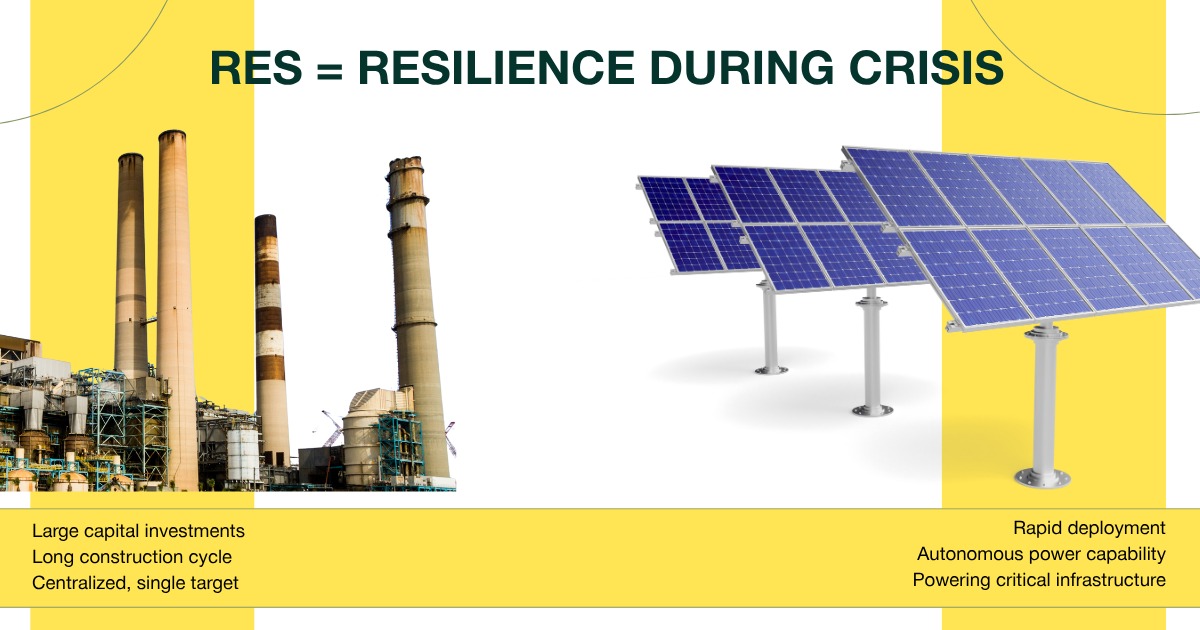
One of the critical advantages of RES, especially during wartime or recovery, is modularity and speed of deployment. Large traditional power plants require years for construction, massive capital investments, and represent singular, large targets.
In contrast, solar panels and small wind turbines can be quickly installed to power individual critical sites—hospitals, schools, military bases, or key enterprises. These systems can be integrated into existing infrastructure or used as autonomous power sources (island systems) in areas where the centralized grid has been destroyed. This ensures critical resilience and accelerates the return to normal life in liberated and affected territories.
Global support and investment flow
The shift to “green” energy is a global trend. While the immediate focus of international partners during the war is certainly on humanitarian needs, investments in RES are viewed as a strategic priority for medium- and long-term recovery and ensuring sustainability.
RES projects, particularly decentralized and hybrid systems, receive prioritized attention from International Financial Organizations and partner governments as part of funding for energy infrastructure reconstruction. Investing in RES not only strengthens the national power system but also positions a business as part of the global ecological and sustainable movement. This opens doors for attracting international capital, concessional loans, grants, and technological partnerships, which are vital for a nation requiring massive reconstruction.
Ecological responsibility: building the future
Although wartime attention is focused on immediate survival, the ecological component cannot be overlooked. Military actions cause colossal damage to the environment. Investments in RES are a commitment to future generations.
This is the path toward building a new, clean, and sustainable energy model that will allow the country not only to rebuild what was destroyed but also to become a leader in ecological technologies. RES is not just an investment in energy; it is an investment in lasting peace and a clean future.
War acts as a catalyst for radical change, demanding a rejection of outdated, vulnerable, and dependent systems. Investing in renewable energy during wartime is more than just a business decision; it is a strategic step toward:
- complete energy independence;
- creation of a resilient and decentralized economy;
- attraction of international financing for reconstruction.
By investing in sun and wind today, we are investing in the strength, security, and prosperity of the country tomorrow.