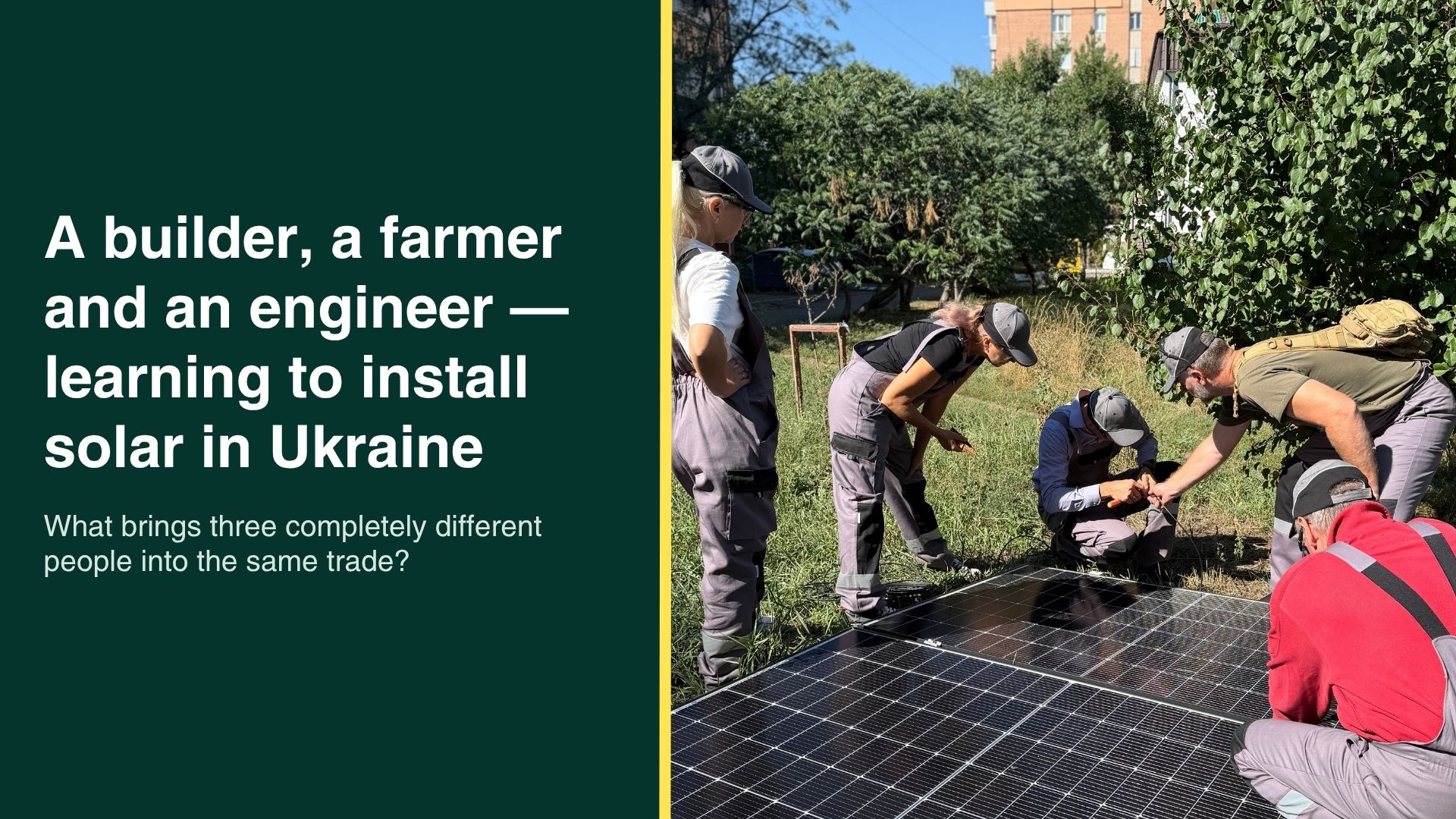
On August 18, RePower Ukraine launched the course “Installation and Operation of Solar Panels” in Poltava, together with the Poltava Center for Vocational Education of the State Employment Service. Until October 1, participants are learning to select equipment, install panels safely, diagnose faults and maintain systems — with hands-on practice on real sites.
The group brings together people with very different backgrounds: some have been installing structures for decades, while for others this is a first step into a technical trade. We spoke with three participants about what brought them to the course and what they expect from it.
Mykhailo: seventeen years of installation work — and one skill he was missing
Mykhailo has no experience with solar plants specifically, but he has spent seventeen years installing construction structures, most of it abroad. He has worked with Polish, French and Portuguese teams, and for nearly two years with Chinese ones.
“When I worked for a Portuguese company, that’s where they taught me to be precise — down to the millimetre.”
Precision matters a great deal for an installer, Mykhailo says: on the course they explain that if a panel is set at the wrong angle, it will generate less electricity.
He first thought about working with solar plants in France, installing boilers under a programme that replaced heating systems for a token fee. That’s where he ran into something he couldn’t do: he connected a boiler, and right next to it solar panels were already in place that had to be tied into the heating as a single system, so a sensor could switch between power sources. That’s what brought him to the course. “It got to me a little — how come I can’t do this? I want to learn this skill too.”
Nataliia Stepaniuk: “I’d like not just to learn, but to find work in this field”
Before the course, Nataliia had no technical education.
“I used to just potter about in my garden with my plants. I always thought I had no aptitude for anything technical.”
And now a woman who not long ago believed she had no head for technology wants to make it her job. The urge to change something came during the blackouts — sitting for long stretches without power, she started wondering how it all works.
An everyday incident pushed her the rest of the way. Nataliia ordered windows, and they were installed crooked. She had to work out for herself how it should have been done and fix it. Having sorted out the windows, she took on solar plants — and this time she wants not just to understand it for herself, but to establish herself in a new profession.
Anastasiia: “I worked as a designer, but I need more hands-on installation practice”
Anastasiia already had experience as a designer — she took the solar plant design course at RePower Ukraine. Now she has decided to look at solar plants from the installation side, to understand them more fully. She is herself displaced from Kharkiv.
She has already worked on real projects — outpatient clinics in Kherson and Kharkiv oblasts, where her role was the design part.
“I know the subject from the paper side — from the documentation. What’s missing is the hands, the site, the live installation. So for me the main thing on this course isn’t the lectures, it’s the trips to real sites.”
More vacancies than specialists
One person is missing a single skill, another is struggling to keep up with the market, another is starting from scratch. But underneath it all lies the same cause: in solar energy there is more work than there are hands able to do it. RePower Ukraine’s research confirmed it — almost half of the sector’s vacancies remain unfilled.
For RePower Ukraine, the Poltava course is part of systematic work: together with the State Employment Service, we are training the workforce that will determine whether there is anyone to build and maintain Ukraine’s renewable energy. A hospital with its own power supply, a water utility that keeps running during blackouts, a school with light in its bomb shelter — all of it rests on people who know how to install and start up solar plants. That is why RePower Ukraine invests in those entering the profession: together with partner state institutions, it arranges practice on real sites and support with employment.
The project “Resilience: Building a Sustainable and Inclusive Labour Market in Ukraine” is implemented under an agreement between Sida and Helvetas Swiss Intercooperation, with the support of Sweden.
Responsibility for the content of this material lies with RePower Ukraine Foundation. All statements and opinions expressed in this material are those of the authors and do not necessarily reflect the official position of the Government of Sweden, Sida or Helvetas Swiss Intercooperation.