“Solar ReStart” is a free RePower Ukraine programme that trains people to install and design solar power plants. Demand for these skills is growing: according to RePower Ukraine’s study on the labour market in the renewable energy sector, 44% of vacancies in Ukraine’s energy sector went unfilled in 2025. Hospitals, schools, businesses and households are installing solar power plants, yet the industry lacks people who can design and install them.
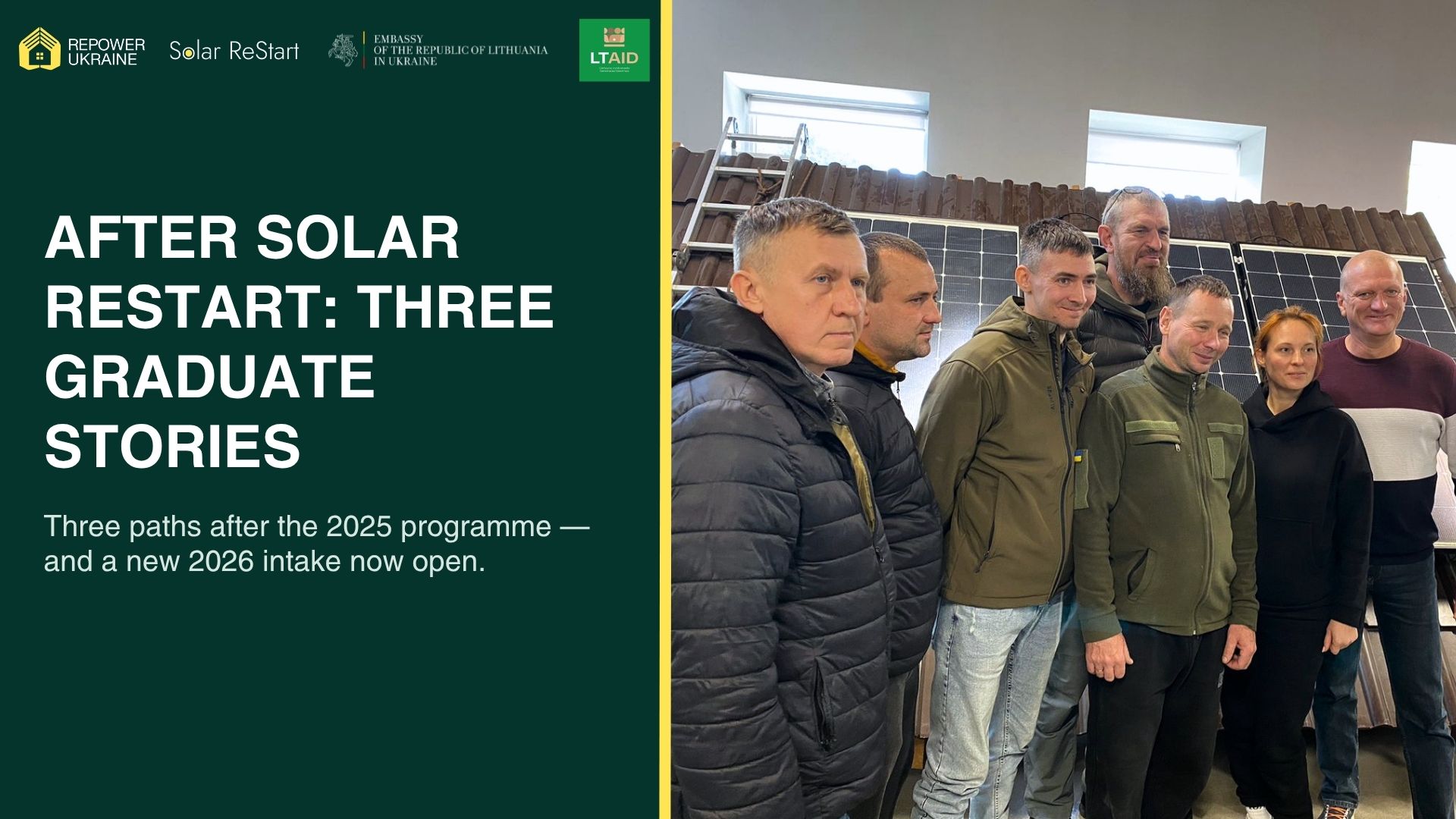
In August, RePower Ukraine will open a new intake for its free “Solar ReStart” programme, aimed at veterans and internally displaced people. Ahead of the launch, we spoke with three of the programme’s graduates — an entrepreneur and serviceman, a veteran with 27 years of service, and a construction cost estimator. They told us about their first job in the field, their plans to start their own businesses, and a profession that can become a new footing.
Ihor Ilchenko: gaining experience as a solar installer, with his own business next
Ihor Ilchenko is a veteran who was an entrepreneur before the war:
“I’ve worked as an employee and as a top manager, and I’ve owned various businesses too. So as an entrepreneur, I understand which lines of work have prospects.” After four years in the military, he chose to build a career in solar energy.
Ihor applied for the solar power plant installer course without hesitation and with the intention of getting a thorough grasp of it: “I decided this knowledge would come in useful, because I was planning to install solar panels both at my own home and at the parents’ home of my brother-in-arms.” Their solar plant is already installed; his own is still in the plans — and this time he’ll build the whole station entirely on his own.
What stayed with him most from the course was the installation on a real site:
“There was a great deal of theory on the course, but the practice is still the most interesting part: when you’re working on a real roof with real tasks and real materials.”
From training to his first job in solar
Ihor found work quickly — a friend from the same course invited him to join his firm. He’s been in his current job for a few months now, and he sees it as reconnaissance before starting his own business:
“What interests me in this job right now is the experience. I’m taking in as much as I can for myself — about working with different roof types, about how the system components and solar cells behave.”
Ihor is interested not only in what’s being installed en masse today, but also in where the market is heading — flexible panels, solar tiles, where the photovoltaic cell is built into the roof itself.
Because his goal ahead is his own installation company, and he already speaks of it not as a dream but as a calculation — he even knows what crew he’ll start with:
“A full crew is four people: three installers and one electrician. Once I’ve gained the experience, I’ll start building my team.”
Olena Dobrova, Vinnytsia: “After the full-scale war began, nothing frightens me anymore”
Twenty-seven years of service, a communications engineer, senior officer rank. Olena came to the installation course because of her son, who is training in the same field at college:
“When he was in his first year, he wanted to tell me something about his studies, and then he said: ‘Mum, you won’t understand anyway.’ And I thought — what do you mean I won’t understand? I have an engineering degree. That was probably one of the triggers. And today he and I speak the same language,” Olena says.
She deliberately chose installation over design: “In recent years, I’ve wanted to work with my hands rather than my head. I’ve always found it easier to deal with machinery than with people, anyway. The human psyche doesn’t forgive mistakes, but with machinery it’s simpler: here you can always unscrew something and put it right.”
On the solar installer track she knew exactly what she was getting into, and she wasn’t afraid of the physical work:
“I’m 49, but that depends not on sex or age but on physical fitness. And after the full-scale war began, nothing frightens me anymore.”
Her knowledge paid off right away: when her neighbours were setting up a solar plant, Olena calculated the capacity, the number of panels, the batteries and the inverters for them.
And her plan ahead is a plan for two — she and her son are thinking about a shared business:
“Whether I’ll be the installer myself, or handle the organisational side while my lads go out to the sites — I already understand how the process is organised. And thanks to the ‘Solar ReStart’ course, I have a solid foundation.”
Khrystyna Babych, Pivdennoukrainsk: “The war has broken down the boundaries between men’s and women’s work”
Khrystyna’s story is about professions that have stopped having a “sex.”
“The war has broken down the boundaries between men’s and women’s work,” she says.
Back in 2022, when her husband went to the front, Khrystyna took over his business — selling and installing PVC windows. Alongside that, she had worked for over ten years as a cost estimator in construction. Later, she lost her husband in the war. Thanks to her earlier experience, moving into a new field didn’t feel like a leap into the unknown.
“The training to become a solar plant design engineer was superb — the instructor explained everything well. The course gave me an understanding of how the plants work down to the smallest detail: for example, if even a little shade falls on a single panel, the whole string will produce reduced energy,” she recalls.
Her knowledge came in handy at home right away: Khrystyna advised her parents, who happened to be installing solar panels on their roof at the time.
“Because of the massive shelling, the power now goes out often — across the whole country, and in our town too,” Khrystyna says.
Her parents’ household in Pivdennoukrainsk is now fully self-sufficient. It has been a real lifeline for them at a time when prolonged power outages have become an everyday reality.
She hasn’t yet found a job in the field: in a small town there are few vacancies, and no one takes on a newcomer without experience for remote work. But she isn’t giving up on her goal:
“I keep turning the idea over in my head anyway — and I’ll definitely work in this field.”
A new intake for “Solar ReStart” is coming soon
All three graduates agree on the main point — the profession is needed right now.
Olena sees it through a soldier’s eyes:
“Because of the war, I see how much destruction we have, how many problems there are with blackouts. This field is genuinely needed — not by me personally, but by our society.”
Khrystyna is certain about the outlook:
“Solar power plants are the future — more and more people are switching to independent energy.”
And Ihor adds the practical side: he found work in the field quickly, while still on the course, and he’s convinced that demand for installers will only keep growing.
That’s why the programme isn’t stopping. “Solar ReStart” has been running since 2023, and this August RePower Ukraine is opening its fourth intake — free training for veterans, both men and women, and their family members who want to master the profession of solar power plant designer or installer. Participants can expect theoretical modules and hands-on practice with real equipment. This intake is part of the “Green Energy Training Courses for Veterans in Ukraine” project, funded by the Ministry of Foreign Affairs of the Republic of Lithuania.
Registration is open until 24 August, and training begins on 14 September. Solar energy is looking for people. If you’re planning to apply for the fourth “Solar ReStart”, keep an eye on the announcements on RePower Ukraine’s pages.
You can download the full report “The State of the Labour Market and Educational Opportunities in the Renewable Energy Sector in Ukraine” (2025) at this link.